
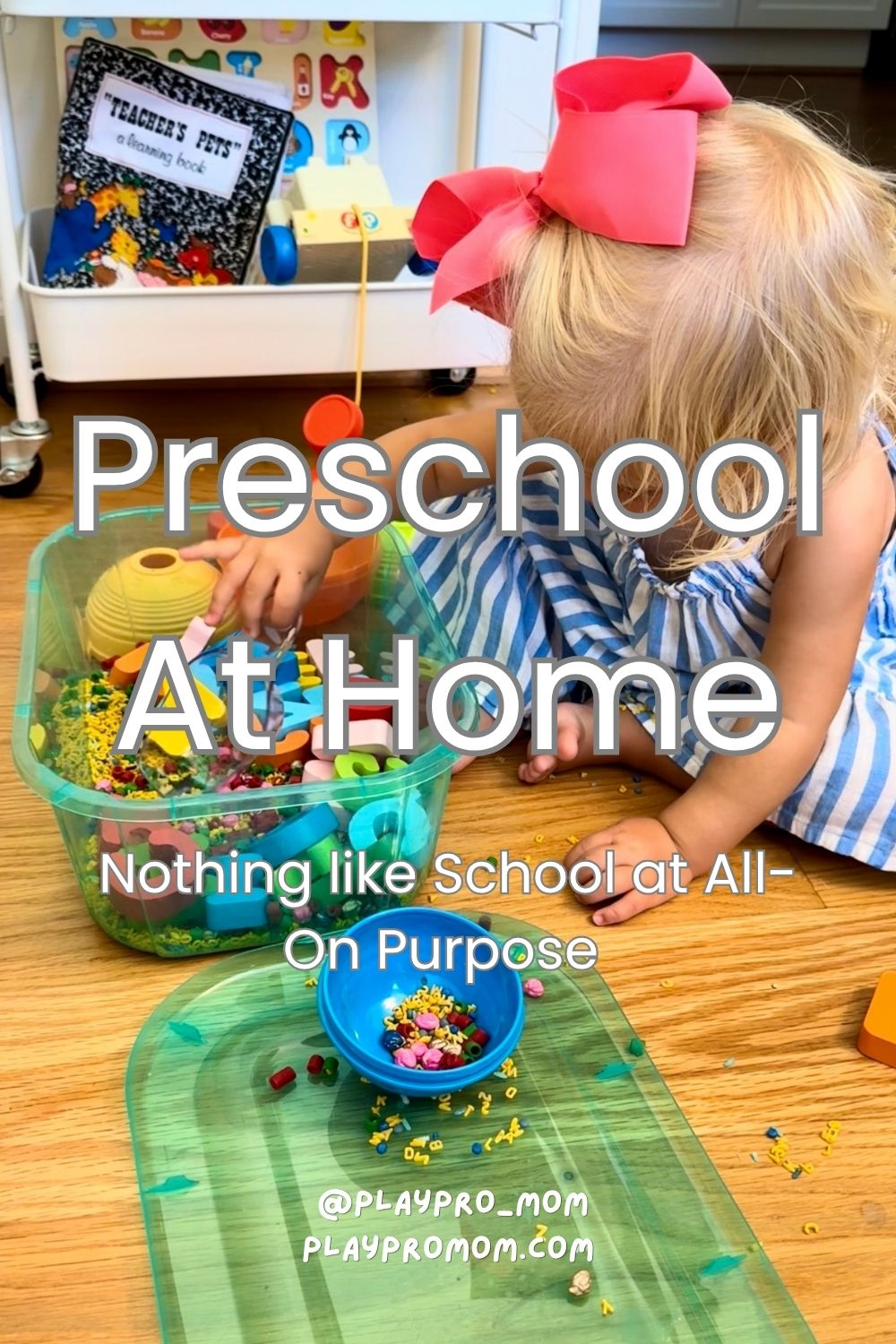
It’s back to school season for kids, and although I am not sending anyone off to school, I am doing a version at home preschool with 10 components- but it’s probably not what you expect.
My 3-year-old loves all things school.
She wants to play school with me, Little Sis, and her baby dolls constantly. We even have a basket of “home school” supplies- dot markers, ABC and number playdoh cards, counting bears, and dry erase boards.
(As an Amazon associate and brand affiliate, I may earn a small commission at no additional cost to you for linked items. Thanks for support this page!)
Despite this, I find myself actively pushing back against the norm to jump into anything too academic just yet.
Pushing Back
I will certainly follow her interest to “play school”, sprinkling in letter shapes and sounds along the way, but I will also continue to actively emphasize other things for now.
I intend to homeschool my girls, Lord willing, when the time comes. I know that any foundations I help lay now are a gift (or curse) to my future self.
So while my little one does enjoy talking about letters, shapes, and numbers, I am confident we will get to that. Its called the Preschool years for a reason- PRE school. As in all the skills our little ones need BEFORE school.
Its other things I am choosing to be intentional about this year.

Nothing Like School at All
There are some easily over-looked ways I intend to use this school year of ‘At Home Preschool’. Most of them look nothing like school at all. That’s on purpose.
Many of these are things that will carry on for the entirety of childhood and are just part of living in our house.
All of them are things that take discipline and intentionality on my part.
None of it will be perfect.
Most days will be messy. I am forever learning on this parenting journey- mostly that I have to rely on God hour by hour.
As I think through what I want to foster in our home over this preschool year, I can’t help but here my dad’s voice in my head quoting Proverbs 29:18, “Where there is no vision, the people parish.” Likewise, without some prayerful intentionality in motherhood, the year will slip by without me realizing it.
10 Parts of Preschool at Home
- Independent Play:
I am a firm believer that there is no better way for 3 year olds to fill the day- unstructured, open ended, uninterrupted play. Done outside as much as possible.
Just like anything else, the ability to dive deep into rich independent play is a skill- one built through connection, foundational developmental skills, and repeated opportunity.
If you need practical strategies, I lay out a clear, step-by-step framework for building the skill of independent play in the introduction of my Big Book of Play, before all of the play set ups and expansions.
- Gross Motor Purposeful Play:
Okay, I cannot help but nerd out a little about the benefits of certain types of gross motor play on brain development for preschoolers. This year, I am aiming to take 5 minutes a day to play some type of gross motor game with my toddler that emphasizes crossing midline, whole body coordination, reflex integration, or body awareness.
You can see a few classic examples here, but I will continue to share our journey with this in stories on the @playpro_mom page too.
You can see a few classic examples here, but I will continue to share our journey with this in stories on the @playpro_mom Instagram page too.

- Character Discipleship:
I am in this for the long haul. One day, Lord willing, I will be homeschooling my children for real and regardless, we will be living together for a long time.
I aim to raise children that are pleasant to be around.
At 3, that looks like doing my best to instill obedience, generosity, gentleness, kindness, etc. The catch- right now, that mostly comes from seeing how I model those things. Oof.
That means discipling my preschooler’s character is more about my own daily reliance on God than anything.
Only God can change and shape their hearts. It is just my duty to point the way.
- Emotional Regulation:
If you have a 3 year old in your home, you already know- there are a lot of big feelings.
Starting to navigate that is a skill set- not just to label and name emotions, but to be able to pivot focus, accept the answer no, or celebrate a win without putting someone else down.
A few ways this plays out in our home right now: talks in the car to prep for situations, reading emotionally smart books, playing board games as a family, and consistent discipline.
I am far from perfect or an expert at teaching this (hello- I am still building these skills in my 30s!), just aiming to be intentional and open to learning what works for other families.
- Sensory Regulation:
Again, something I really like to nerd out about, but that I also aim to make practical in my home.
There are true rebellious, behavior problems and then there are sensory regulation difficulties. The more I can equip my children to recognize when they feel dysregulated and equip them with the tools to navigate that, the smoother things will feel for everyone.
At 3, that looks redirecting bouncing off the walls and being too rough around the baby with movement. Instead, I will send her to go do 5 “jump and freezes” on her mini trampoline then swing from the hanging bar 5 times. Slow, counting out loud. It is telling her to go use her kid’s porch swing before we start our afternoon rest time. Its giving deep pressure joint squeezes when she is getting restless in church.
- Real Aloud:
This has quickly become a new favorite in our home.
We have always read short favorite children’s books, sometimes more in a day than I cared to count.
It was not until my sister brought a read aloud chapter book to “Cousin Camp” though that I realized we were missing out on bigger stories.
This has been an easy way to connect in little pockets of the day. Sometimes, the story may completely go over her head until we talk it through. Other times, I am completely surprised by how much of it she has absorbed.
Either way, its building language skills, and is just something we can both enjoy.
On days I need more of a break, listening to beginner chapter audio books does the trick too. A lot of times, I turn these on for afternoon rest time or at bedtime. You can try it out with a 30 day free Audible trial. (Affiliate link- may earn commission. Thank you!)

- Memory Verses and Bible Time:
The ultimate goal with any early language skills- to help hide God’s Word in my children’s hearts from an early age.
The verses I can quote easily as an adult are the ones that I learned in preschool and kindergarten. We started a family verse of the week a few months ago using these cards. Most weeks, its our 3 year old that can quote it first.
The verses I can recall easily as an adult are the ones that I learned in preschool and kindergarten. We started a family verse of the week a few months ago using these cards. Most weeks, its our 3 year old that can quote it first.
- Outings and Playdates:
Besides the independent play, this is a huge reason that I refuse to rush into a set academic curriculum too soon.
I would rather prioritize lived experiences in this season- exploring all Charleston has to offer, navigating the social dynamics of playdates, and hosting people in our home.
Some opportunities that came up just this week: observing the differences in the species of sea turtles at the aquarium’s turtle hospital; negotiating toy trades with a friend at the beach; crossing streets, walking, and standing in line to visit a downtown bakery; and working together to clean up at the end of a playdate.
To an adult, these seem like nothing.
To a preschooler, every single one is a learning experience.
- Fine Motor Crafts:
There is nothing my daughter loves more right now than a glue craft.
Part of this area of focus is simply following her interest, but it’s also such a win for development- hand strength, dexterity, spatial awareness, visual processing.
A craft is never just a craft. A few things I am making sure to include for ‘at home preschool’: scissor practice, squeeze glue, painting, coloring, stringing beads, playdough.
While we have no set craft time or activity plan, these materials come out over and over again throughout the week, often while I’m working in the kitchen.
- Self Care and Home Care Skills:
I have a saying that I use constantly in our home, “We take care of each other, and we take care of our stuff.” In other words- be nice and clean up behind yourself.
For preschool, I am working through teaching any lingering issues with dressing, wiping, hand washing, and bathing.
I am also steadily building in the expectation of helping care for our space.
I do not have a designated chore chart at this stage. I care more about instilling observing what needs to be done and the willingness to be helpful right now.
That looks like ‘gifting’ the role of silverware unloader or cabinet wiper, noticing and thanking for helpful things done without asking, and laying out the expectation of cleaning up toys before dinner.
And of course, lots of baking together. It’s one of our favorite ways to spend time together. It’s also an easy way to sprinkle in math skills without ever touching a worksheet.

We may not get to all 10 parts of “At Home Preschool” every day, but these are the underlying priorities.
None of this will look perfect in our home. It does not have to.
It’s simply being intentional about my days with my preschooler and knowing that there is no need to run past this stage.
Let me know below- what would you add to this list? What are you prioritizing for preschool?
Let’s go steward the day!
Related articles: Low-Tox Swaps for Back-to-School Swaps
Share this Blog:


Latest on the Blog


